
Chiropractic treatment is defined as a hands-on, regulated healthcare intervention that restores joint mobility, reduces musculoskeletal pain, and improves nervous system function through targeted manual therapy. To fully understand the chiropractic treatment approach, you need to know that it centers on two core mechanisms: high-velocity low-amplitude (HVLA) spinal adjustments and mechanoreceptor activation, both of which work together to relieve pain and restore movement. Clinical practice guidelines classify chiropractic as a multimodal musculoskeletal intervention, meaning it combines manual therapy, soft tissue work, and rehabilitative exercise rather than relying on a single technique. Evertonchiropractic, led by Dr. Richard, applies this evidence-informed model to help patients move better and stay active long term.
What does the initial chiropractic assessment involve?
The first chiropractic visit focuses primarily on thorough assessment and red-flag screening, not immediate treatment. This surprises many patients who expect an adjustment on day one. The clinical interview and physical examination come first because they determine whether chiropractic care is appropriate and which techniques are safe for your specific condition.
A complete initial assessment typically includes:
- Comprehensive health history: Your chiropractor reviews your symptom timeline, prior treatments, medications, work habits, and lifestyle factors that may contribute to your pain.
- Postural and range of motion testing: Standing posture, spinal curvature, and joint mobility are measured to identify structural imbalances.
- Neurological examination: Reflexes, muscle strength, and sensation are tested to detect nerve involvement, particularly relevant for sciatica or radiating arm pain.
- Diagnostic imaging: X-rays or MRI scans are ordered only when clinically necessary, such as when fracture, disc pathology, or significant degeneration is suspected.
- Red-flag screening: Conditions like fractures, tumors, infections, or inflammatory arthritis require referral rather than chiropractic adjustment. Identifying these early protects patient safety.
The information gathered shapes every decision that follows, from which techniques are used to how much force is applied. Skipping this step would be like a mechanic replacing parts without running a diagnostic first.
Pro Tip: Bring a list of all previous imaging, surgeries, and medications to your first appointment. This cuts assessment time and helps your chiropractor build a more accurate picture of your condition from the start.
How do chiropractic techniques relieve pain and improve function?
Chiropractic care uses several distinct techniques, each targeting a specific aspect of musculoskeletal dysfunction. The choice of technique depends on your diagnosis, age, pain level, and tissue sensitivity.
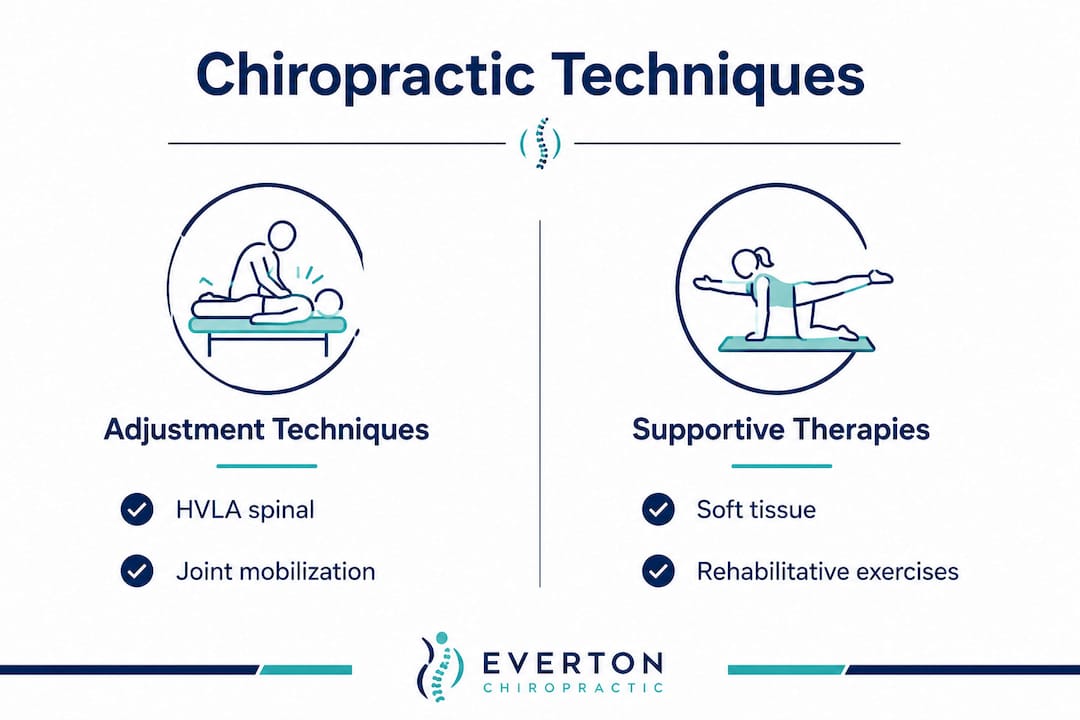
1. HVLA spinal adjustments
HVLA adjustments deliver a controlled force within 150 milliseconds, moving a joint approximately 1–2 mm beyond its passive range. That rapid thrust activates joint mechanoreceptors, which send signals to the spinal cord that inhibit reflexive muscle guarding almost immediately. The result is reduced muscle tension and restored joint motion. For a deeper look at the physiology behind this, Evertonchiropractic’s spinal adjustment guide explains the neurological pathway in plain terms.

2. Joint mobilization
Mobilization uses slower, rhythmic movements within the joint’s normal range. It suits patients who are too sensitive for HVLA, including older adults or those with acute inflammation. The technique improves synovial fluid circulation and gradually increases range of motion without the audible pop associated with HVLA.
3. Soft tissue therapy
Muscle release techniques, trigger point therapy, and myofascial work address the surrounding musculature that often tightens in response to joint dysfunction. Treating only the joint while ignoring the muscles produces short-lived results.
4. Rehabilitative exercises and posture advice
Exercises prescribed between sessions reinforce the mobility gains achieved on the table. Posture correction and ergonomic advice reduce the mechanical load that caused the problem in the first place.
Understanding cavitation: The audible “pop” during an adjustment is cavitation, caused by a rapid pressure drop in the joint’s synovial fluid that releases dissolved gas. It is not bones cracking. Clinical benefit does not depend on hearing the sound. Many effective adjustments produce no noise at all.
| Technique | Primary target | Typical use case |
|---|---|---|
| HVLA spinal adjustment | Joint mobility and nerve inhibition | Acute and chronic spinal pain |
| Joint mobilization | Range of motion | Sensitive patients, older adults |
| Soft tissue therapy | Muscle tension and trigger points | Adjunct to all spinal conditions |
| Rehabilitative exercise | Strength and stability | Prevention and long-term function |
Pro Tip: Ask your chiropractor which technique they plan to use before each session. Understanding the method helps you relax, and a relaxed patient responds better to manual therapy.
How is a personalized chiropractic care plan developed?
Chiropractic care plans are built from the initial assessment findings and your stated goals, then adjusted as your body responds. Treatment typically runs 4–12 weeks, though the exact duration depends on clinical progress rather than a fixed schedule.
Most care plans follow three phases:
- Relief care: Sessions are more frequent, often two to three times per week, with the goal of reducing acute pain and inflammation. Techniques during this phase tend to be gentler and more targeted.
- Corrective care: As pain decreases, the focus shifts to restoring full joint mobility, improving posture, and addressing the underlying mechanical cause. Session frequency drops to once or twice per week.
- Wellness care: Once functional goals are met, periodic visits maintain the gains and prevent recurrence. Frequency varies by individual lifestyle and physical demands.
Ongoing reassessment drives every transition between phases. Your chiropractor measures functional benchmarks, such as range of motion, pain scores, and activity tolerance, rather than simply counting sessions. Visit frequency is adjusted based on these objective markers, not a predetermined schedule.
Patient participation is not optional. Home exercises, posture corrections, and ergonomic adjustments are critical to sustaining treatment gains and preventing recurrence. Patients who complete their prescribed home program consistently reach their functional goals faster than those who rely solely on in-clinic sessions.
What are the proven benefits of chiropractic treatment?
Chiropractic care produces measurable improvements across several health domains, not just short-term pain relief. The evidence base has grown substantially, and the outcomes extend well beyond the spine.
Early chiropractic care for noncancer spine pain reduces the odds of opioid prescription by 67%, based on data from over 6 million patients. That figure reflects a meaningful shift in how musculoskeletal pain can be managed without medication dependency.
Key documented benefits include:
- Reduced musculoskeletal pain: Spinal adjustments and soft tissue therapy decrease pain intensity and improve tolerance for daily activity.
- Improved joint mobility: Patients regain range of motion in the spine, hips, and shoulders that had been restricted by muscle guarding or joint stiffness.
- Better sleep quality: Chiropractic care added to usual medical care shows meaningful improvements in sleep disturbance sustained at 52 weeks. Poor sleep worsens pain perception, so this benefit compounds over time.
- Improved physical function and social participation: The same long-term study documented gains in physical function and social role performance, areas that pain often erodes quietly over months or years.
The distinction between short-term relief and longer-term wellness outcomes matters. Pain relief can occur within the first few sessions. Structural and functional improvements take longer and require consistent engagement with the full care plan. Patients who treat chiropractic as a broader functional health strategy rather than a quick fix report the most durable results.
Key Takeaways
Chiropractic treatment is a structured, evidence-based process that combines HVLA spinal adjustments, soft tissue therapy, and patient-led rehabilitation to reduce pain, restore mobility, and improve long-term function.
| Point | Details |
|---|---|
| Assessment comes first | The initial visit focuses on history, examination, and red-flag screening before any treatment begins. |
| HVLA adjustments work neurologically | A 150-millisecond thrust activates mechanoreceptors that inhibit muscle guarding and restore joint motion. |
| Care plans have three phases | Relief, corrective, and wellness phases guide frequency and technique selection based on clinical progress. |
| Early care reduces opioid risk | Starting chiropractic care early for spine pain cuts opioid prescription odds by 67% in large-scale data. |
| Patient participation drives results | Home exercises and posture corrections are required to sustain gains and prevent recurrence. |
Why chiropractic care rewards patience more than most treatments
Patients often walk into a chiropractic clinic expecting the same experience as a massage or a quick medical consultation. What they get is something more demanding and, ultimately, more rewarding.
The part that surprises people most is how much the outcome depends on them. The adjustment is a catalyst, not a cure. I have seen patients with identical diagnoses get completely different results based on one variable: whether they did their home exercises. The ones who engaged with their prescribed program, corrected their sitting posture, and came back for reassessment consistently outperformed those who relied on the table alone.
The audible pop during an HVLA adjustment also deserves a direct word. Patients sometimes judge the session’s success by whether they heard it. That is a mistake. Cavitation is a byproduct of gas release in synovial fluid. It tells you nothing about whether the joint moved correctly or whether the neurological response was triggered. A silent adjustment can be just as effective.
Chiropractic care also works best when it is part of a wider plan. Combining it with physiotherapy approaches or targeted mobility work produces better outcomes than either intervention alone. The spine does not exist in isolation, and neither should your treatment.
The patients who get the most from chiropractic are the ones who treat it as a health investment rather than a rescue service. They show up consistently, they do the work between sessions, and they communicate openly with their chiropractor when something changes. That combination is what turns short-term relief into long-term function.
— Aman
How Evertonchiropractic can support your recovery
Evertonchiropractic applies the evidence-based principles outlined in this article to every patient it sees. Dr. Richard’s approach starts with a thorough clinical assessment, builds a personalized care plan around your specific goals, and adjusts that plan as your body responds.

Whether you are dealing with lower back pain, sciatica, or chronic nerve pain, Evertonchiropractic’s treatment model combines spinal adjustments for pain relief with soft tissue therapy and rehabilitative exercises to address the root cause rather than the symptom. For patients managing persistent nerve-related pain, the clinic’s nerve pain treatment program targets the source directly. Book a consultation to find out which approach fits your condition and goals.
FAQ
What happens on your first chiropractic visit?
The first visit focuses on health history, physical examination, and red-flag screening. Treatment may begin the same day if the assessment confirms chiropractic care is appropriate.
Is the popping sound during an adjustment necessary?
No. Cavitation, the audible pop, results from gas release in synovial fluid and does not determine whether the adjustment was effective. Many successful adjustments produce no sound.
How long does a chiropractic care plan typically last?
Most care plans run 4–12 weeks, progressing through relief, corrective, and wellness phases based on clinical progress rather than a fixed session count.
Can chiropractic care reduce the need for pain medication?
Early chiropractic care for noncancer spine pain reduces opioid prescription odds by 67%, based on a meta-analysis of over 6 million patients, making it a clinically supported alternative to medication-first approaches.
Does chiropractic treatment help with sleep?
Yes. Research tracking patients over 52 weeks found that adding chiropractic care to standard medical treatment produced meaningful, sustained improvements in sleep disturbance, likely because reduced pain lowers nighttime arousal.