Spinal adjustments, formally known as spinal manipulative therapy (SMT), are manual techniques that restore proper alignment to spinal joints, reduce nerve irritation, and improve mechanical function to relieve pain. Clinical guidelines in 2026 recommend SMT as a first-line conservative treatment for both acute and chronic low back pain, with effect sizes that are statistically superior to placebo and comparable to NSAIDs. The role of spinal adjustments in pain relief extends beyond simple realignment. Adjustments reduce inflammation, modulate nerve signaling, and address the psychological factors that drive chronic disability. Understanding these mechanisms is the first step toward making an informed decision about your care.
How do spinal adjustments work to relieve pain?
Spinal manipulation works primarily through neurophysiological mechanisms, not structural tissue changes. High-velocity, low-amplitude thrusts applied to spinal joints modulate spinal reflexes and alter nociceptive processing pathways. In plain terms, the adjustment changes how your nervous system interprets and transmits pain signals. That shift happens quickly, which is why many patients feel relief within the first few sessions.
The mechanical effects are equally significant. Adjustments restore normal joint movement, reduce muscle hypertonicity, and decompress irritated nerve roots. When a spinal segment is restricted or misaligned, surrounding muscles guard the area by staying contracted. That sustained tension compounds the original pain. Restoring joint motion breaks that cycle.

At the tissue level, manual therapy reduces inflammatory mediators including prostaglandins and cytokines. Lower levels of these compounds mean less local swelling and less chemical irritation of nearby nerves. The result is a measurable reduction in both pain intensity and the area of the body that feels painful.
Key physiological effects of spinal adjustments include:
- Spinal reflex modulation: Adjustments reset overactive muscle reflexes that lock joints in painful positions.
- Nociceptive processing changes: The nervous system recalibrates how it registers and amplifies pain signals.
- Inflammation reduction: Prostaglandins and cytokines drop after treatment, reducing chemical nerve irritation.
- Improved blood circulation: Restored joint motion increases local blood flow, supporting tissue repair.
- Autonomic nervous system activation: Adjustments trigger measurable systemic responses, including blood pressure changes.
Pro Tip: Ask your chiropractor to explain which specific joints they are targeting and why. Patients who understand the mechanism of their treatment report better outcomes and stick with their care plans longer.
What types of pain can spinal adjustments effectively treat?
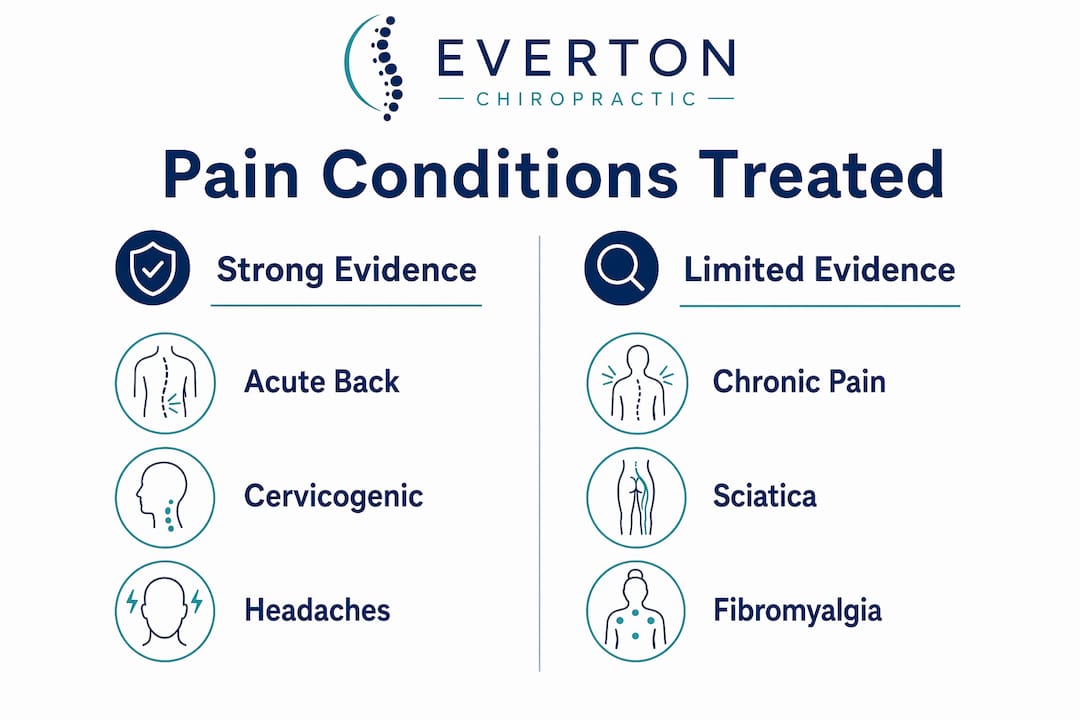
The evidence base for spinal manipulation covers several distinct pain conditions, each with a different strength of support.
- Acute low back pain. SMT produces small to moderate improvements in pain and function. Guidelines now place it alongside NSAIDs as a first-choice option before prescription medication.
- Chronic low back pain. Combining SMT with exercise and self-management produces better long-term outcomes than either approach alone. Standalone adjustments help, but the gains are more durable when paired with movement.
- Neck pain. Spinal manipulation combined with exercise achieves better pain reduction at 3 and 6 months than either treatment alone. This combination also produces systemic effects such as reduced systolic blood pressure.
- Cervicogenic headaches. These are headaches originating from the cervical spine. Cervical spinal manipulation shows sustained reductions in headache frequency and intensity, with randomized trial benefits lasting up to 12 months. Evertonchiropractic offers a dedicated cervicogenic headache treatment program for patients dealing with this specific pattern.
- Posture-related musculoskeletal tension. Office workers and people with sedentary lifestyles accumulate joint restriction and muscle tension in the thoracic and cervical spine. Adjustments combined with postural correction address both the symptom and the cause.
The table below summarizes the evidence strength for each condition:
| Condition | Evidence strength | Best approach |
|---|---|---|
| Acute low back pain | Strong | SMT alone or with exercise |
| Chronic low back pain | Moderate | SMT plus exercise and coaching |
| Neck pain | Moderate to strong | SMT combined with exercise |
| Cervicogenic headaches | Strong | Cervical SMT, sustained benefit |
| Posture-related tension | Moderate | SMT with postural correction |
Spinal manipulation is not appropriate for everyone. Contraindications include fractures, severe osteoporosis, active infection near the spine, and certain vascular conditions. A thorough intake assessment by a qualified chiropractor identifies these risks before treatment begins.
How do spinal adjustments compare with other pain relief treatments?
Spinal manipulation holds its own against pharmacologic options. Effect sizes for SMT are comparable to NSAIDs for low back pain, without the gastrointestinal and cardiovascular risks that come with long-term NSAID use. For patients who cannot tolerate anti-inflammatory medications, SMT is a clinically supported alternative.
Against physical therapy and exercise alone, the picture is more nuanced. Neither approach consistently outperforms the other when studied head to head. The clearest finding is that combining SMT with exercise and movement coaching produces better outcomes than either treatment in isolation. That combination addresses both the joint mechanics and the muscular conditioning that supports long-term spinal health.
The safety profile of spinal manipulation is favorable. Lumbar manipulation carries low risk, and serious complications are rare, occurring mainly with high-velocity cervical techniques in patients with undetected vascular risk factors. Mild soreness after an adjustment is common and typically resolves within 24 hours. That profile compares well with opioid analgesics, muscle relaxants, and even prolonged NSAID courses.
| Treatment | Pain relief | Key risk | Best suited for |
|---|---|---|---|
| Spinal manipulation | Small to moderate | Rare, mostly cervical | Back pain, neck pain, headaches |
| NSAIDs | Small to moderate | GI and cardiovascular | Short-term acute pain |
| Exercise therapy | Moderate | Low | Chronic pain, prevention |
| Combined SMT + exercise | Moderate to strong | Low | Chronic and recurrent pain |
Pro Tip: If your current treatment plan relies on a single modality, ask your provider about adding either exercise or spinal manipulation to the mix. The evidence consistently favors combined approaches over single-treatment programs.
What are the long-term benefits of spinal adjustments beyond immediate pain relief?
The benefits of spinal adjustments extend well past the treatment table. Patients often report improvements in sleep, anxiety, and social function before their pain fully resolves. A study involving 750 active-duty military participants found that adding chiropractic care to usual medical treatment improved sleep disturbances at 52 weeks. That finding matters because poor sleep amplifies pain perception and slows recovery.
Spinal manipulation also addresses the psychological dimension of chronic pain. Unhealthy pain expectations and beliefs impact disability as much as biomechanical factors do. Adjustments reduce these negative perceptions, which breaks the cycle of fear, avoidance, and deconditioning that traps many people in chronic pain. This is not a minor side benefit. It is a primary mechanism of recovery.
Long-term benefits patients and clinicians observe include:
- Improved sleep quality: Reduced pain and muscle tension support deeper, more restorative sleep.
- Better functional status: Patients return to activities they had avoided, from exercise to work tasks.
- Reduced reliance on medication: Sustained pain control through SMT lowers the need for ongoing analgesic use.
- Healthier pain beliefs: Patients develop more realistic and constructive expectations about their bodies.
- Prevention of recurrence: Regular spinal care combined with exercise reduces the frequency of flare-ups over time.
For patients dealing with lower back pain treatment that lasts, the goal is not just to feel better today. It is to build a spine that functions well for years.
What should patients consider when choosing spinal adjustment therapy?
Choosing the right provider and care structure matters as much as the treatment itself. A well-run chiropractic practice does not just perform adjustments. It builds a plan that includes movement education, exercise prescription, and realistic goal-setting.
Signs of evidence-based chiropractic practice include:
- Thorough intake assessment: A qualified chiropractor takes a full history, screens for contraindications, and explains the diagnosis clearly before any treatment begins.
- Integrated care plan: Adjustments are paired with specific exercises and self-management strategies, not offered as a standalone fix.
- Transparent outcome tracking: Progress is measured at regular intervals using functional benchmarks, not just pain scores.
- Clear communication about expectations: Honest practitioners tell you how many sessions are likely needed and what realistic improvement looks like.
- Referral when appropriate: A trustworthy chiropractor refers out when a condition falls outside their scope or requires imaging or specialist review.
Common misconceptions about spinal adjustments include the belief that the “cracking” sound indicates bones moving back into place. That sound is actually gas releasing from the joint capsule. The therapeutic effect comes from the neurophysiological response, not the noise. Patients who understand this tend to have better experiences and more realistic expectations. Evertonchiropractic’s approach, led by Dr. Richard, prioritizes patient education alongside hands-on treatment so that every person leaves with a clear picture of their condition and their path forward.
Key takeaways
Spinal adjustments relieve pain by modulating nerve signaling, reducing inflammation, and improving joint mechanics, with the strongest outcomes achieved when combined with exercise and self-management.
| Point | Details |
|---|---|
| SMT is a first-line treatment | Clinical guidelines recommend spinal manipulation for both acute and chronic low back pain. |
| Neurophysiology drives the effect | Adjustments change how the nervous system processes pain, not just how joints are aligned. |
| Combined care outperforms solo treatment | Pairing SMT with exercise produces better results at 3 and 6 months than either alone. |
| Long-term benefits go beyond pain | Patients report improved sleep, reduced anxiety, and better function alongside pain relief. |
| Provider quality shapes outcomes | Evidence-based practice includes intake screening, exercise integration, and outcome tracking. |
What I’ve learned about spinal adjustments after years of watching patients recover
The research on spinal manipulation is solid, but the clinical reality is more interesting than the studies suggest. The patients who recover fastest are rarely the ones who simply show up for adjustments and leave. They are the ones who engage with the full picture: the exercises, the posture habits, the understanding of why their spine got into trouble in the first place.
What surprises most people is how much the psychological shift matters. When a patient stops believing their back is fragile and starts trusting their body to move again, the physical recovery accelerates. That is not motivational language. It is what the research on pain beliefs actually shows. Adjustments create a window of reduced pain and improved movement. What you do in that window determines whether the relief lasts.
The honest answer to “does chiropractic help pain?” is yes, with conditions. It helps most when it is part of a plan, not a standalone treatment. Practitioners who tell you otherwise are selling you short.
— Aman
Evertonchiropractic’s approach to spinal adjustment care
Evertonchiropractic, led by Dr. Richard, builds every treatment plan around the evidence: spinal adjustments paired with targeted exercise, movement coaching, and clear patient education.
The clinic’s focus on spinal alignment treatment goes beyond symptom relief. Each patient receives a personalized plan designed around their lifestyle, goals, and physical history. Whether you are dealing with chronic lower back pain, posture-related tension, or recurring headaches, the approach addresses the root mechanics rather than masking the symptom. If you are ready to move better and stay active as you age, Evertonchiropractic offers a consultation to map out a care plan built for lasting results. You can also explore their lower back pain relief guide for a deeper look at what evidence-based conservative care looks like in practice.
FAQ
What does a spinal adjustment actually do?
A spinal adjustment applies a controlled force to a restricted joint, restoring movement and triggering neurophysiological changes that reduce pain signals. The primary effect is on the nervous system, not on physically “moving bones back into place.”
How many sessions does it take to feel relief from back pain?
Most patients with acute low back pain notice improvement within 4–6 sessions, though chronic conditions typically require a longer course combined with exercise. Realistic timelines depend on the severity of the condition and how consistently the patient follows the full care plan.
Are spinal adjustments safe?
Spinal manipulation carries a favorable safety profile compared to pharmacologic treatments, with serious complications being rare and mostly associated with high-velocity cervical techniques in patients with undetected vascular risk factors. Lumbar manipulation is considered low risk.
Can spinal adjustments help with headaches?
Cervical spinal manipulation shows strong evidence for reducing the frequency and intensity of cervicogenic headaches, with benefits lasting up to 12 months in randomized trials. Patients with neck-related headaches are among the strongest responders to chiropractic care.
Do spinal adjustments work for chronic pain?
Spinal manipulation produces meaningful improvements in chronic low back pain, particularly when combined with exercise and self-management coaching. The treatment also reduces unhealthy pain beliefs, which are a major driver of long-term disability independent of physical damage.