
Preparing your body for a spinal adjustment is defined as a multi-step process combining physical warm-up, neurological priming, and practical pre-visit steps that together make chiropractic care safer, more effective, and longer-lasting. The industry term for this process is “pre-adjustment preparation,” and it covers everything from what you wear to how your nervous system responds when the chiropractor applies force to a joint. Most patients focus entirely on showing up. The ones who get the best results show up ready. Evertonchiropractic builds this preparation into every patient plan because the adjustment itself is only part of the equation.
What to wear and bring to your chiropractic appointment
Practical preparation starts before you leave the house. What you wear directly affects what your chiropractor can assess and adjust. Loose, stretchy clothing like yoga pants, athletic shorts, or a fitted T-shirt gives the clinician full access to your spine, hips, and shoulders without restriction. Avoid rigid jeans, belts, underwire bras, or high heels. These limit movement and make accurate postural assessment harder.
Beyond clothing, bring the right documents. First-visit preparation includes your photo ID, insurance card, a current medication list, and any prior imaging such as X-rays or MRI scans. Arriving 10–15 minutes early gives you time to complete intake paperwork without rushing. Rushing raises your stress response, which tightens muscles before you even get on the table.
What you eat and drink also matters. Stay well hydrated the day before and the morning of your appointment. Avoid heavy meals within two hours of your visit, since a full stomach can cause discomfort when lying face-down. Skip alcohol and stimulants on the day of your appointment. Both affect muscle tone and your nervous system’s baseline state.
- Do: Wear athletic or stretchy clothing, arrive early, bring imaging and medication records
- Do: Sleep 7–8 hours the night before to support tissue recovery and nervous system regulation
- Don’t: Wear restrictive clothing, eat a heavy meal right before, or consume alcohol beforehand
- Don’t: Perform intense exercise the morning of your appointment, since muscle fatigue can complicate assessment
Pro Tip: Take a photo of your medication bottles on your phone before the visit. If you forget the physical list, you have a backup ready in seconds.
How does soft tissue preparation improve adjustment results?
Soft tissue work is the most underused part of pre-adjustment preparation. Adjusting a joint without addressing surrounding muscle hypertonicity often results in those muscles pulling the joint right back out of position. Pre-adjustment muscle work changes that outcome by reducing the resistance the chiropractor has to work against.
Three soft tissue techniques are most relevant here.
- Effleurage: Long, gliding strokes along muscle bellies that increase local circulation and reduce surface tension. This is typically the starting point before deeper work.
- Ischemic compression: Sustained pressure applied directly to a trigger point until the tissue releases. Ischemic compression interrupts muscle guarding by altering neurological feedback loops, which makes the joint more receptive to adjustment.
- Percussion therapy: Rapid mechanical pulses delivered to muscle tissue to reduce tone and increase blood flow. This technique is contraindicated over acutely inflamed tissue, so clinical judgment always applies.
The neurological mechanism behind all three is the same. Soft tissue work stimulates Golgi tendon organs and muscle spindles, which are sensory receptors embedded in muscle and tendon tissue. When these receptors fire, they signal the central nervous system to reduce motor output to that muscle. The result is a measurable drop in muscle tone before the adjustment begins.
Effective chiropractic preparation requires tailoring interventions. Acute inflammation, hypermobility, and individual tolerance all dictate modifications to standard prep techniques. What works for one patient may be contraindicated for another.
Functional Range Release (FR) is a more advanced technique that combines precise pressure with controlled movement to restore healthy range of motion. It targets the functional capacity of the muscle, not just its resting length. Clinicians trained in FR use it to address restrictions that standard massage cannot reach.
Pro Tip: If you have a foam roller at home, spend five minutes rolling your thoracic spine before your appointment. Keep the movement slow and controlled, not aggressive. This primes the area without causing inflammation.
Best stretches and exercises to warm up before a chiropractic session
Stretching before an adjustment is not about flexibility. It is about communicating safety to your nervous system. PNF stretching exploits autogenic inhibition, a neurological reflex that allows muscles to relax and lengthen beyond their normal resting state. This directly improves joint range of motion before the chiropractor applies any force.
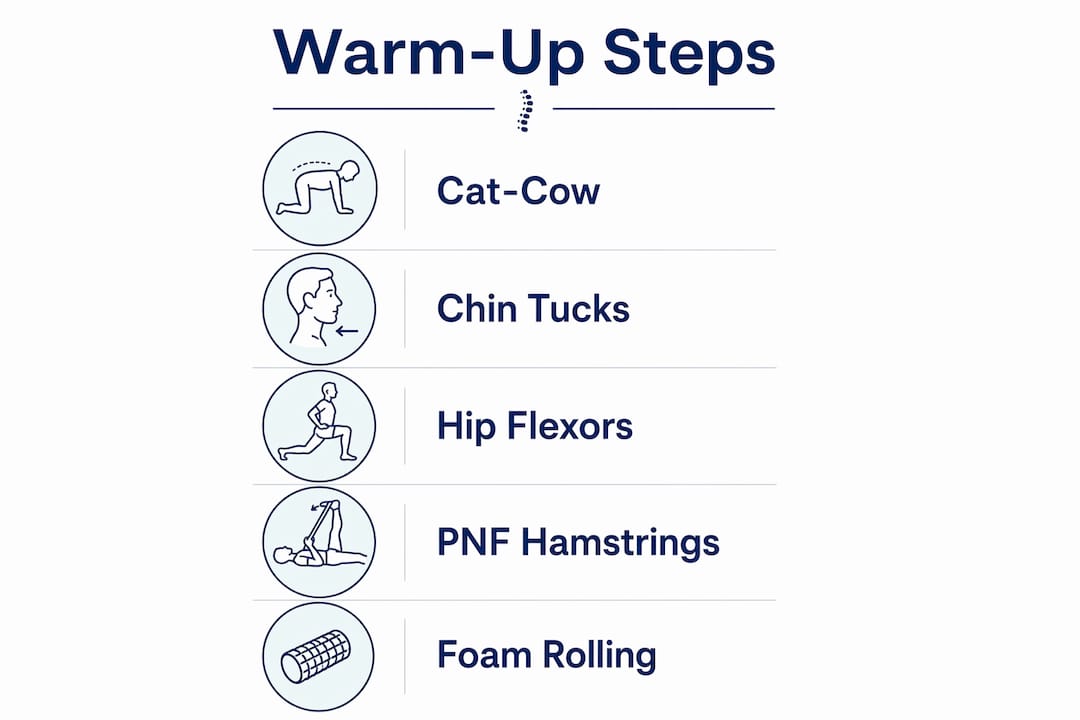
A practical pre-adjustment warm-up takes 10–15 minutes and targets the spine, neck, and hips. Here is a step-by-step sequence:
- Cat-cow (2 minutes): On hands and knees, alternate between arching and rounding your spine. Move slowly and breathe into each position. This mobilizes the thoracic and lumbar spine without loading it.
- Chin tucks (1 minute): Standing or seated, gently draw your chin straight back. Hold for three seconds, release. This activates deep cervical flexors and reduces forward head tension.
- Hip flexor stretch (2 minutes per side): Kneel on one knee with the other foot forward. Shift your weight forward gently until you feel a stretch at the front of the hip. Tight hip flexors pull the lumbar spine into extension, which complicates lower back adjustments.
- PNF hamstring stretch (2 minutes per side): Lie on your back and lift one leg. Contract the hamstring against gentle resistance for six seconds, then relax and extend the stretch further. Repeat three times per side.
- Thoracic rotation (2 minutes): Seated in a chair, cross your arms over your chest and rotate your upper body left and right. Keep your hips still. This targets the mid-back, which is often the most restricted segment.
Consistent daily mobility exercises of 10–15 minutes prevent stiffness from accumulating between appointments and maintain your body’s readiness for chiropractic care. One session of stretching before an appointment helps. Daily practice changes your baseline.
| Exercise | Target area | Duration | Key benefit |
|---|---|---|---|
| Cat-cow | Thoracic and lumbar spine | 2 minutes | Mobilizes vertebral segments |
| Chin tucks | Cervical spine | 1 minute | Reduces forward head tension |
| Hip flexor stretch | Hip and lumbar junction | 2 min per side | Releases lumbar extension pull |
| PNF hamstring stretch | Posterior chain | 2 min per side | Exploits autogenic inhibition |
| Thoracic rotation | Mid-back | 2 minutes | Increases rotational range |

For safe technique guidance, Evertonchiropractic’s resource on improving spinal mobility covers each movement in detail with clinical context.
Why does mental readiness matter before a spinal adjustment?
Mental state directly affects how your body responds to an adjustment. When you arrive tense or anxious, your muscles guard subconsciously. Guarding means your nervous system is bracing for threat, which increases muscle tone and reduces joint mobility. The chiropractor then has to apply more force to achieve the same therapeutic result.
Mental priming techniques that reduce subconscious guarding create a neurological environment where adjustments require less force and produce more effective therapeutic outcomes.
The goal is to arrive feeling “primed, not braced.” Prior soft tissue therapy reduces guarding and shifts the patient’s nervous system into a more receptive state. This is why clinics that perform muscle work before adjusting consistently report better patient comfort and more durable results.
Your mindset also shapes what you notice during the session. Patients often expect their first visit to be mainly adjustment, but it typically involves a detailed history and physical exam. Understanding this in advance reduces the surprise factor and keeps your nervous system calm. Slow diaphragmatic breathing in the waiting room is a simple technique that lowers your baseline sympathetic tone before you even enter the treatment room. Breathe in for four counts, out for six. Repeat five times.
Clinician communication matters too. A chiropractor who explains each step before performing it gives your nervous system time to process and accept the input. That verbal priming is part of the preparation, not separate from it.
Common mistakes when preparing for a spinal adjustment
Most preparation errors fall into one of two categories: doing too little or doing too much. Both reduce adjustment effectiveness.
- Skipping soft tissue prep: Arriving with tight, guarded muscles forces the chiropractor to work against resistance. The adjustment may still occur, but the joint is more likely to return to its restricted position quickly.
- Wearing restrictive clothing: Jeans, belts, and tight waistbands limit the clinician’s ability to assess posture and apply techniques accurately. This is one of the easiest mistakes to fix.
- Overdoing pre-appointment exercise: A hard gym session the morning of your appointment creates muscle fatigue and micro-inflammation. Both interfere with assessment accuracy and tissue response.
- Ignoring acute inflammation: Applying percussion or deep pressure over an acutely inflamed area is contraindicated and requires modified protocols. If you are flaring up, tell your chiropractor before the session begins.
- Treating preparation as a one-time event: Patients often treat physical prep as a one-time event rather than a consistent habit. Long-term spinal health requires daily mobility work, not just pre-appointment stretching.
Pro Tip: If you are unsure whether a specific exercise or technique is appropriate for your condition, message your chiropractor before the appointment. A two-minute conversation can prevent a preparation mistake that sets your session back.
Key Takeaways
Preparing your body for a spinal adjustment requires consistent soft tissue work, targeted stretching, mental priming, and practical pre-visit steps that together produce safer, more effective, and longer-lasting chiropractic outcomes.
| Point | Details |
|---|---|
| Wear the right clothing | Loose, stretchy athletic wear gives your chiropractor full access and improves assessment accuracy. |
| Do soft tissue work first | Techniques like ischemic compression reduce muscle tone before adjustment, improving joint receptivity. |
| Use PNF stretching | Autogenic inhibition from PNF stretching relaxes muscles beyond their resting state before the session. |
| Prime your nervous system | Slow breathing and mental calm reduce guarding, so adjustments require less force and hold longer. |
| Build daily mobility habits | Ten to fifteen minutes of daily movement prevents stiffness and maintains readiness between appointments. |
What I have learned from watching patients prepare (and not prepare)
The difference between a patient who prepares and one who does not shows up within the first two minutes on the table. Prepared patients have less muscle guarding, respond faster to soft tissue work, and report less discomfort during the adjustment itself. That is not anecdotal. It is consistent enough that preparation has become a non-negotiable part of how I think about chiropractic care.
What surprises most people is how much the neurological side matters. You can do all the right stretches and still arrive mentally braced for something uncomfortable. That tension undoes a significant portion of the physical prep. The nervous system does not distinguish between physical and psychological threat. Both produce the same guarding response.
The other thing I push back on is the idea that preparation is something you do the morning of your appointment. Real preparation is a long-term spinal health routine built into your daily life. Patients who move consistently between sessions get more from each adjustment. The adjustment reinforces a body that is already moving well, rather than trying to force movement in a body that has been static all week.
My honest advice: treat your pre-adjustment routine the same way you treat brushing your teeth. It is not optional, and it is not complicated. Ten minutes of movement, a good night’s sleep, and a calm mindset will do more for your adjustment outcomes than any single technique.
— Aman
How Evertonchiropractic supports your pre-adjustment preparation
Evertonchiropractic takes preparation seriously because Dr. Richard has seen firsthand how much it changes patient outcomes. Every new patient receives a personalized evaluation that identifies which soft tissue techniques, stretches, and mobility exercises are appropriate for their specific condition and goals.

The clinic’s evidence-informed protocols include soft tissue work before every adjustment, tailored to whether you are dealing with acute inflammation, chronic stiffness, or hypermobility. Patients also receive guidance on daily movement habits that support long-term spinal health between sessions. If you are ready to get more from every adjustment, book a consultation with Evertonchiropractic and start with a preparation plan built around your body.
FAQ
What should I wear to a chiropractic adjustment?
Wear loose, stretchy clothing like yoga pants or athletic shorts. Restrictive clothing like jeans or belts limits postural assessment and adjustment access.
How early should I arrive for my first chiropractic visit?
Arrive 10–15 minutes early to complete intake paperwork and bring your photo ID, insurance card, medication list, and any prior imaging.
What stretches help prepare the body before an adjustment?
Cat-cow, chin tucks, hip flexor stretches, and PNF hamstring stretches are the most effective pre-adjustment movements. A 10–15 minute sequence targeting the spine, hips, and neck is sufficient.
Why does muscle tension affect chiropractic adjustment results?
High muscle tone around a joint forces the chiropractor to work against resistance. Without soft tissue preparation, muscles often pull the joint back out of position after the adjustment.
How often should I do pre-adjustment exercises?
Daily mobility work of 10–15 minutes produces the best results. One-time preparation before an appointment helps, but consistent daily movement maintains spinal readiness between sessions.