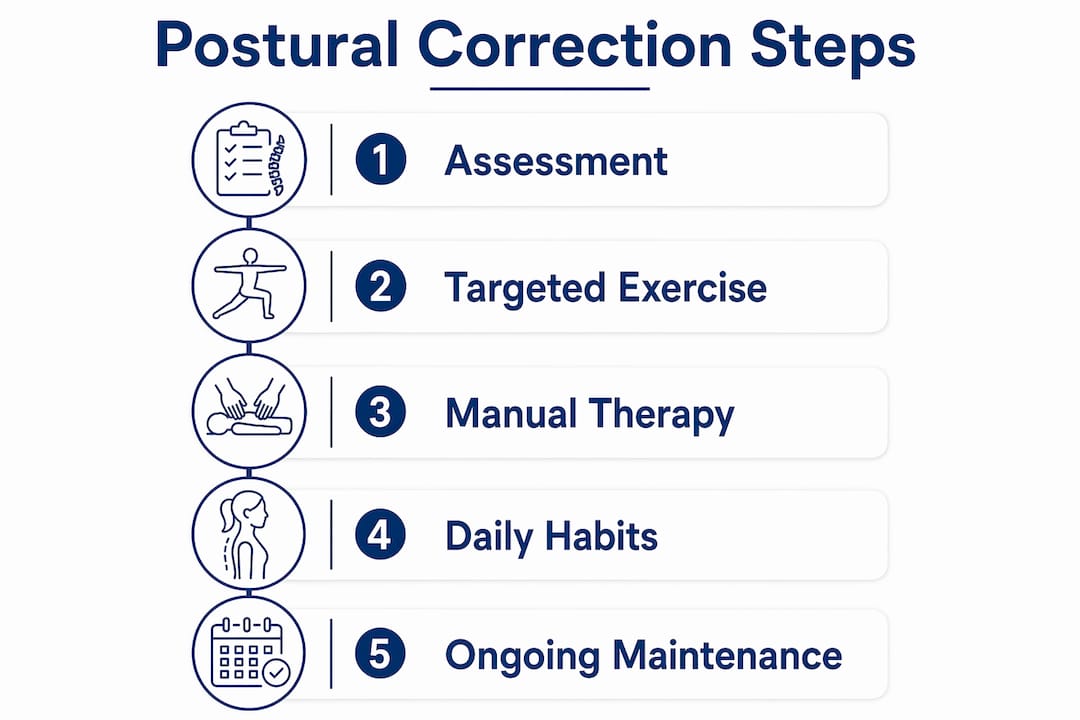
Postural correction treatment is a personalized, multimodal process that assesses your body’s alignment, identifies muscle imbalances, and applies targeted interventions to reduce pain and restore functional movement. A clinical assessment typically covers your history, static and dynamic posture, strength and mobility tests, and an ergonomic evaluation, all of which shape a treatment plan built around your specific imbalances. The goal is not to hold a rigid “perfect” posture but to improve how your body moves and adapts throughout the day.
The core components of postural correction treatment include:
- Corrective exercises targeting the core, mid-back, deep neck flexors, and glutes
- Manual therapy such as joint mobilization, trigger point therapy, and soft tissue work
- Ergonomic education covering workstation setup, footwear, and daily movement habits
- Breathing mechanics training to support core stability and structural alignment
- Awareness and self-monitoring strategies to carry improvements beyond the clinic
Table of Contents
- What exercises are used in posture correction programs?
- How does manual therapy fit into postural treatment?
- Do posture correctors and supportive devices actually help?
- What are the benefits of postural correction treatment?
- How do you maintain good posture through daily habits?
- What Evertonchiropractic’s clinical approach tells us about effective treatment
- Postural correction care at Evertonchiropractic
- Key Takeaways
- FAQ
What exercises are used in posture correction programs?
Exercise is the backbone of any posture correction program. Strengthening underused muscles and restoring mobility in tight areas are both necessary; neither alone gets the job done.
Strengthening exercises focus on the muscles most commonly weakened by modern sedentary habits:
- Chin tuck nods to activate deep neck flexors and counter forward head posture
- Prone Ys and Ts to strengthen mid-back and scapular stabilizers
- Scapula squeezes to retract rounded shoulders
- Dead bugs to build deep core stability without loading the spine
- Glute bridges to activate the posterior chain and support lumbar alignment
- Modified planks to develop overall trunk endurance
Mobility exercises address the areas that tend to lock up first:
- Chest stretches (arms clasped behind the back) to open the pectoral muscles
- Thoracic extension over a foam roller to restore mid-back range of motion
- Hip flexor stretches to counteract prolonged sitting
A PMC-published study found that an exercise program performed three times per week for eight weeks produced significant reductions in shoulder, mid-back, and lower back pain. That kind of structured consistency is what separates real progress from temporary relief.
Modern clinical thinking goes further than simple “stretch tight, strengthen weak.” Current evidence prioritizes neuromuscular control and self-awareness training, building the brain-body connection that keeps good movement patterns automatic rather than effortful.
| Exercise Type | Target Area | Primary Benefit |
|---|---|---|
| Chin tuck nods | Deep neck flexors | Reduces forward head posture |
| Prone Ys and Ts | Mid-back, scapular stabilizers | Corrects rounded shoulders |
| Dead bugs | Deep core | Spinal stability without compression |
| Glute bridges | Glutes, posterior chain | Lumbar support and pelvic alignment |
| Thoracic extension | Mid-back | Restores spinal mobility |
| Hip flexor stretches | Hip flexors | Counteracts prolonged sitting effects |
| Chest stretches | Pectorals | Opens the front of the shoulder |
Pro Tip: Diaphragmatic breathing, practiced during exercise, does double duty. It stabilizes the core and trains the nervous system to regulate posture more efficiently, making it one of the highest-return habits in any postural restoration program.
How does manual therapy fit into postural treatment?
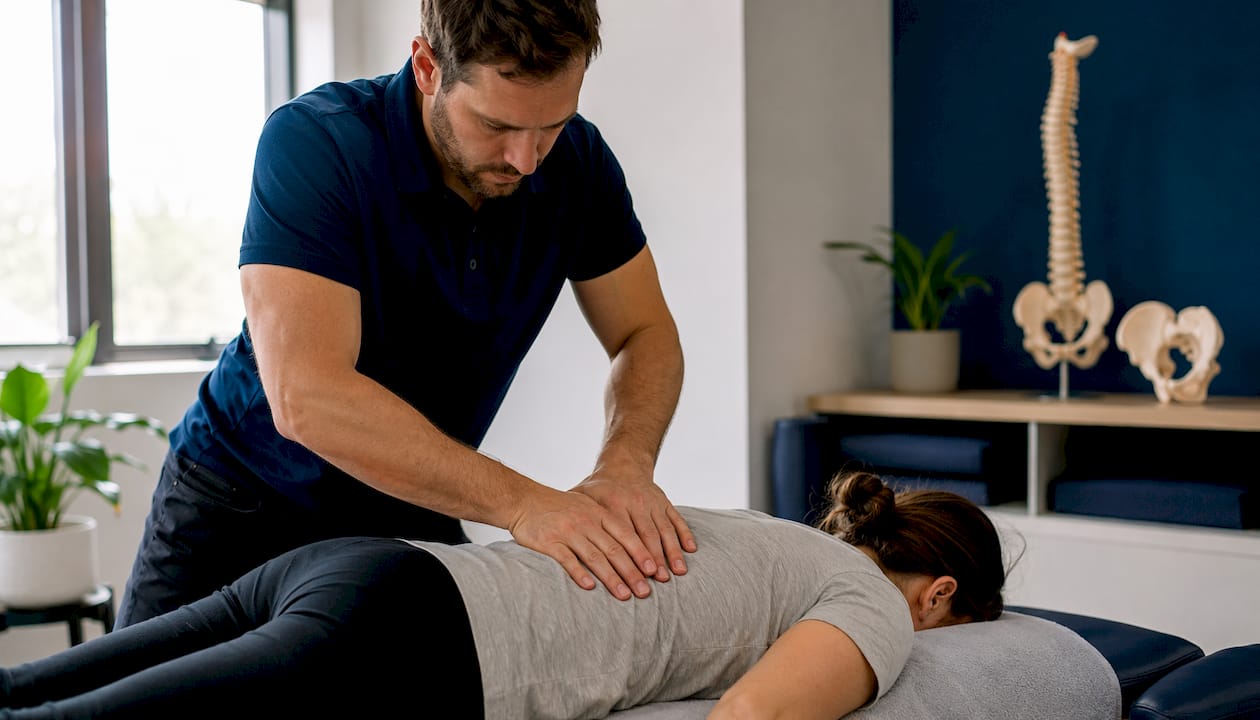
Exercises build the capacity for better posture, but manual therapy clears the roadblocks that prevent you from getting there. Tight joints and overloaded soft tissue restrict movement before you even attempt a corrective exercise, and manual techniques like joint mobilization and soft tissue work address those restrictions directly.
Key manual therapy techniques used in postural correction:
- Joint mobilization: Graded movements applied to stiff spinal or peripheral joints to restore range of motion and reduce pain
- Trigger point therapy: Targeted pressure on hyperirritable muscle knots that refer pain and limit movement, particularly in the upper trapezius, levator scapulae, and suboccipital muscles
- Soft tissue mobilization: Hands-on work to reduce fascial restrictions and muscular tightness in areas like the chest, hip flexors, and thoracic paraspinals
- Myofascial release: Sustained pressure techniques that address connective tissue tension contributing to postural collapse
Manual therapy works best as a complement to exercise, not a substitute. Mobilizing a stiff thoracic segment makes thoracic extension exercises immediately more effective. Releasing a tight pectoral muscle means a scapula squeeze can actually reach the range it needs to. The two approaches reinforce each other.
Do posture correctors and supportive devices actually help?
Posture correctors, lumbar rolls, and ergonomic chairs can play a useful role in treatment, but their value depends entirely on how you use them. Harvard Health notes that these devices work best as positional reminders and muscle activators, not as long-term crutches. Worn too long without active strengthening, they can actually weaken the muscles they are meant to support.
Common device types and how to use them well:
- Posture corrector straps: Useful for short periods (20–30 minutes) to cue shoulder retraction and build awareness; pair with active exercises for best results
- Lumbar rolls: Placed in the lumbar curve of a chair, they reduce disc pressure during prolonged sitting and reinforce the spine’s natural curve
- Ergonomic chairs: Adjustable lumbar support and seat depth reduce strain during desk work, but no chair replaces regular movement breaks
- Standing desks: Alternate between sitting and standing to avoid sustained loading in any single position
- Cervical pillows: Support the natural neck curve during sleep, reducing overnight muscle strain
The dependency risk is real. Relying on a brace instead of building muscular control means the underlying weakness never gets addressed. Think of a posture corrector as training wheels: helpful early on, but the goal is always to ride without them.
What are the benefits of postural correction treatment?
The benefits of postural correction extend well beyond standing up straighter. Consistent postural correction reduces chronic pain, eases tension headaches, improves lung capacity, and supports better circulation. Proper spinal alignment also reduces abnormal wear on joints in the neck, shoulders, lower back, and hips, lowering the long-term risk of conditions like osteoarthritis.
Specific outcomes patients commonly experience:
- Neck and back pain relief: Correcting forward head posture and rounded shoulders reduces the mechanical load on cervical and thoracic structures
- Headache reduction: Many tension headaches originate from suboccipital muscle strain driven by poor head position
- Improved breathing: An upright thoracic spine allows the diaphragm to move freely, increasing lung capacity
- Better circulation: Reduced muscular compression on blood vessels improves blood flow to the extremities
- Mood and confidence: Research from Rush University links upright posture to reduced stress on bones and joints, and clinicians note associated improvements in self-perception
- Reduced fatigue: Sustained loading in a fixed position contributes more to pain and fatigue than minor spinal angles; improving movement variability directly reduces tissue stress
- Lower fall risk: Forward posture shifts the center of gravity, increasing fall risk, particularly in older adults
One finding from Harvard Health is worth keeping in mind: it is rarely too late to improve posture, even for older adults or those with prior spinal injuries. Muscle mass responds to training at any age, and neuromuscular control can be retrained with the right program.
How do you maintain good posture through daily habits?
Clinic sessions build the foundation, but daily habits determine whether the gains stick. Postural correction is an ongoing regulation process, not a one-time fix. The most effective approach applies postural awareness to everyday activities, not just during formal exercise.

Workstation setup matters more than most people realize. Ergonomic principles call for monitor height at eye level, elbows bent between 90 and 120 degrees, feet flat on the floor or on a footrest, and full lumbar support. Getting these right removes the structural reasons your body defaults to slouching.
Daily habits that reinforce postural correction:
- Set a movement timer: Get up and move every 20–30 minutes. Sitting for long periods almost always leads to stiffness and slouching, regardless of how good your chair is.
- Practice chin tucks during screen time: A simple cue that counters forward head drift without requiring a break.
- Check your phone position: Tilting the head forward 30 degrees more than triples the stress placed on the neck. Look down with your eyes, not your neck.
- Use a rolled towel when sitting: Placed behind your shoulders, it provides a tactile cue to sit upright without conscious effort.
- Practice diaphragmatic breathing: Three to five slow belly breaths per hour activates the core and resets postural tone.
- Wear supportive, low-heeled shoes: High heels shift your center of gravity forward and force compensatory changes throughout the spine.
- Stay active broadly: Yoga, tai chi, and body-awareness classes all reinforce the movement variability that protects against sustained loading.
The key insight from current clinical practice is that no single position is “correct” for extended periods. Changing positions frequently, even between good positions, reduces cumulative tissue stress more than holding any one posture perfectly.
What Evertonchiropractic’s clinical approach tells us about effective treatment
The most durable postural improvements come from treating the nervous system, not just the skeleton. At Evertonchiropractic, the clinical approach led by Dr. Richard centers on neuromuscular control: training the body’s sensorimotor system to maintain alignment automatically, rather than relying on conscious effort or external supports.
This perspective aligns with where the evidence points. Modern clinical research shows that self-awareness training and neurological adaptations produce more sustainable posture improvements than stretching and strengthening alone. Patients who develop genuine sensorimotor control, the ability to sense and correct their own alignment in real time, maintain their gains far longer than those who rely on passive treatments.
Evertonchiropractic’s model also challenges the assumption that physical decline is inevitable with age. Clinical experience confirms that adults with longstanding postural issues, including those who have healed from spinal fractures, can still make meaningful progress through focused strengthening and neuromuscular training. The ceiling is higher than most patients expect when they walk in the door.
Treatment at Evertonchiropractic is structured around each patient’s lifestyle and goals, not a generic protocol. Someone with chronic lower back pain from desk work gets a different plan than a postpartum patient rebuilding spinal alignment. That specificity is what makes the difference between short-term relief and lasting functional change.
Postural correction care at Evertonchiropractic
Chronic neck pain, a stiff mid-back, or headaches that keep coming back often trace directly to postural imbalances that exercises alone cannot fully resolve. Evertonchiropractic offers a structured, evidence-informed path from assessment to lasting correction, combining chiropractic adjustments, targeted neuromuscular training, and ergonomic guidance into a single coordinated plan.
Dr. Richard’s approach is built around your specific movement patterns and goals, not a one-size-fits-all protocol. Patients dealing with nerve-related pain from postural compression, or those who have tried stretching and foam rolling without lasting results, tend to see the clearest gains from this kind of structured clinical care. You can also review what the evidence shows on spinal adjustments before your first visit.
Book a postural assessment with Evertonchiropractic to get a clear picture of what is driving your symptoms and a plan built around fixing it.
Key Takeaways
Postural correction treatment works by combining clinical assessment, targeted exercise, manual therapy, and daily habit changes to address the root causes of pain and misalignment, not just the symptoms.
| Point | Details |
|---|---|
| Assessment drives everything | A clinical evaluation of alignment, strength, and movement patterns shapes the entire treatment plan. |
| Exercise targets specific muscles | Strengthening the core, mid-back, deep neck flexors, and glutes corrects the imbalances behind most postural pain. |
| Movement variability beats fixed posture | Changing positions frequently reduces tissue stress more than holding any single “correct” posture. |
| Devices support, not replace, active work | Posture correctors and lumbar rolls are useful reminders, but muscle strengthening prevents long-term dependency. |
| Evertonchiropractic combines all three | Dr. Richard’s evidence-informed care integrates chiropractic adjustment, neuromuscular training, and ergonomic guidance into one personalized plan. |
FAQ
Does posture correction really work?
Yes. A published exercise study found significant pain reductions in the shoulders, mid-back, and lower back after eight weeks of structured postural correction exercise, and clinical evidence supports lasting improvements when treatment combines exercise, manual therapy, and daily habit changes.
Is posture correction painful?
Correcting long-standing posture habits can feel uncomfortable for a few weeks as muscles adapt to new positions, but treatment itself should not be painful. Manual therapy and corrective exercises are graded to your tolerance and adjusted as your strength and mobility improve.
How long should I wear a posture corrector each day?
Short sessions of 20–30 minutes are the general clinical guidance, paired with active strengthening exercises. Wearing a posture corrector for extended periods without exercise risks muscle weakening and dependency rather than genuine correction.
What do doctors recommend for posture correction?
Most clinicians recommend a combination of targeted strengthening exercises, manual therapy for joint and soft tissue restrictions, ergonomic adjustments to your workstation, and regular movement breaks throughout the day. For persistent or complex postural issues, working with a physical therapist or chiropractor like those at Evertonchiropractic provides the structured assessment and personalized plan that self-directed efforts often miss.