Poor posture is defined as any sustained misalignment of the spine, joints, and surrounding muscles that increases mechanical stress on tissues over time. That stress accumulates quietly until it produces pain, restricted movement, or outright injury. The good news is that you can prevent injury through better posture by making three targeted changes: correcting your ergonomic setup, strengthening the muscles that support your spine, and scheduling regular movement breaks. Research confirms that posture affects far more than your back. It influences respiratory function, circulation, neural regulation, and even emotional health. This guide gives you the exact strategies to act on that knowledge today.
What are the key ergonomic principles to prevent injury through better posture?
Ergonomic alignment is the foundation of injury prevention, and it starts with understanding that no single cue fixes everything. Optimal ergonomic setups adjust the entire posture chain rather than chasing one correction in isolation. That means screen position, elbow and shoulder alignment, and peripheral device placement all need to work together.
For your computer workstation, apply these correct posture techniques:
- Monitor height: Position the top of your screen at or just below eye level, roughly an arm’s length away. Looking down even 15 degrees for hours at a time multiplies the effective load on your cervical spine.
- Keyboard and mouse placement: Keep both at elbow height so your forearms rest parallel to the floor. An external keyboard and mouse are non-negotiable if you use a laptop for more than two hours a day.
- Chair setup: Sit with your hips slightly higher than your knees, feet flat on the floor or a footrest. Lumbar support should fill the natural curve of your lower back, not push it forward.
- Mobile phone use: Hold your phone at eye level instead of dropping your chin to your chest. “Text neck” is a recognized clinical pattern that loads the cervical spine with up to 60 pounds of force at a 60-degree forward tilt.
- Sleeping position: Side sleeping with a pillow that keeps your head neutral is the safest default. Stomach sleeping rotates the neck for hours and is the single worst position for cervical health.
Pro Tip: Set a phone alarm labeled “posture check” every 45 minutes. A two-second scan of your screen height, shoulder position, and lower back contact with your chair costs nothing and prevents hours of cumulative strain.
The role of posture in health becomes most visible at the workstation because that is where most people spend the majority of their waking hours. Getting the setup right before adding exercise or breaks is the correct sequence. Environmental changes first, then behavioral ones.
How can strengthening core and postural muscles help prevent injury?
Muscle strength is what makes good posture sustainable. Without adequate strength in the core and upper back, even a perfect ergonomic setup will fail because your body will fatigue and collapse into old patterns within the hour.

A 2025 meta-analysis published in Frontiers in Physiology found that Pilates, walking, and tai chi produced the largest reductions in non-specific low back pain among all exercise types studied, with standardized mean differences ranging from 0.81 to 1.14. That is a clinically meaningful effect, comparable to many pharmaceutical interventions. The implication is clear: structured movement is medicine for the spine.
Here is a practical sequence for building postural strength, ordered from foundational to progressive:
- Dead bug (core stability): Lie on your back, arms pointing to the ceiling, knees bent at 90 degrees. Slowly lower one arm and the opposite leg toward the floor while keeping your lower back pressed flat. Return and repeat. This trains deep spinal stabilizers without loading the lumbar spine.
- Bird dog (lumbar and glute activation): On hands and knees, extend one arm and the opposite leg simultaneously, hold for three seconds, and return. This exercise directly trains the muscles that maintain neutral spine during daily tasks.
- Wall angels (thoracic mobility and upper back strength): Stand with your back flat against a wall, arms at 90 degrees. Slide your arms overhead while keeping contact with the wall. Most people discover immediately how restricted their thoracic spine has become.
- Chin tucks (deep cervical flexor activation): Gently retract your chin straight back, creating a “double chin.” Hold for five seconds. This counteracts the forward head position that develops from screen use and is one of the most evidence-supported exercises for neck pain.
- Glute bridges (posterior chain activation): Lie on your back with knees bent, feet flat. Drive your hips toward the ceiling, squeezing your glutes at the top. Weak glutes force the lower back to compensate during every step you take.
Adherence matters more than program complexity. Research shows that high exercise adherence (75% or more of prescribed sessions) produces a pain effect size of 1.98 compared to just 0.72 in low-adherence groups. That is nearly three times the benefit from simply showing up consistently. A simple five-exercise routine done four times a week beats an elaborate program done once.
Pro Tip: Attach your posture exercises to an existing habit, such as doing them immediately after your morning coffee or before your evening shower. Habit stacking removes the decision-making barrier that kills most exercise routines.
The ACSM guidelines recommend combining aerobic, resistance, and flexibility training for optimal lumbar stability outcomes. You do not need to do all three in every session. Rotate them across the week so the total program covers all three domains.
What movement breaks are most effective for posture-related injury prevention?
Static posture is the hidden injury risk that most people overlook entirely. Prolonged sitting elevates intradiscal pressure in the lumbar spine and restricts blood flow to spinal tissues, creating the conditions for both acute injury and chronic degeneration. The problem is not sitting. The problem is sitting without interruption.
“The best posture is your next posture.” This phrase, widely used in occupational health, captures the core principle: no single position is safe when held indefinitely. Variety and movement are the actual protective factors.
The 20/8/2 rule offers a practical framework for desk workers. For every 30 minutes, spend 20 minutes sitting, 8 minutes standing, and 2 minutes moving. Ergonomic standards from ISO and occupational health guides specifically recommend this kind of structured interruption, noting that sit-stand desks alone are insufficient without scheduled movement breaks.
Practical strategies for building movement into your day include:
- Micro-stretches at your desk: Cervical side bends, shoulder rolls, and seated thoracic rotations take under 60 seconds and reset accumulated tension.
- Walking meetings: Replace seated one-on-one calls with walking conversations. This adds movement without cutting into your schedule.
- Task variation: Alternate between tasks that require different postures. Switch from typing to a phone call, which lets you stand and pace.
- Standing for transitions: Stand every time you take a phone call, read a document, or wait for a file to load. These micro-opportunities add up to 30 or more minutes of standing per day without any deliberate effort.
The cumulative tissue stress model explains why these breaks matter so much. Tissue damage from posture is not caused by a single bad position. It builds from repeated low-level loading without adequate recovery. Scheduled breaks are the recovery window your spine needs.
How do safe lifting techniques and daily habits contribute to injury prevention?
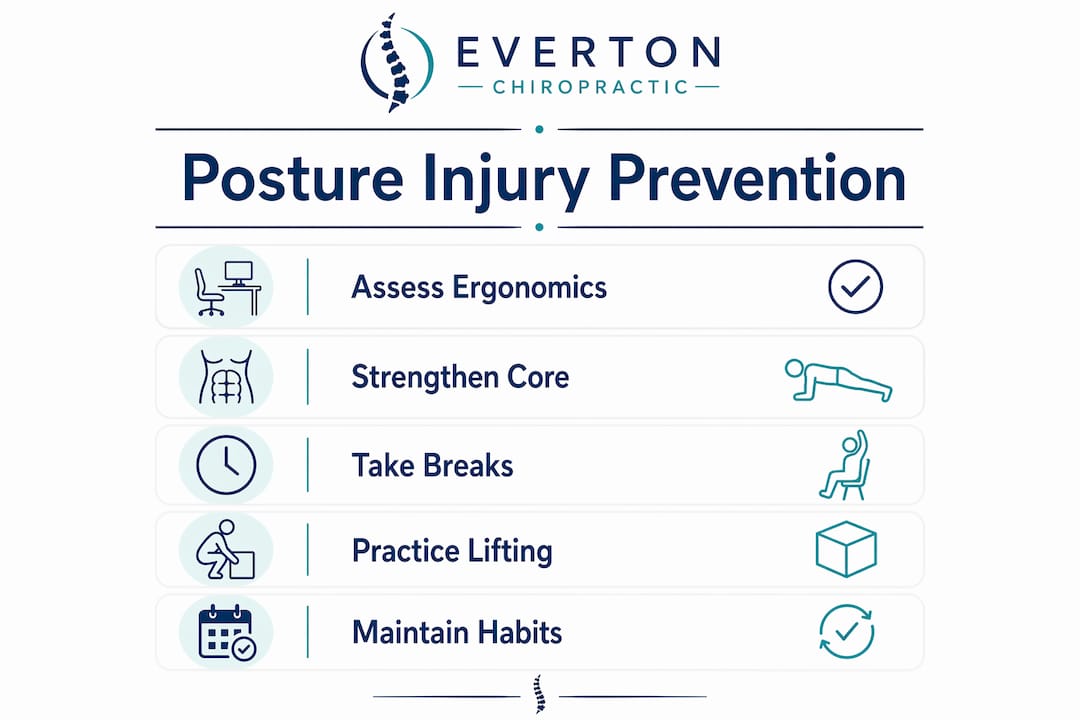
Lifting injuries are among the most preventable, yet they remain one of the leading causes of spinal damage. The mechanics of safe lifting are straightforward, but they require conscious practice until they become automatic.
Follow this sequence every time you lift anything heavier than a grocery bag:
- Position your feet: Stand with feet shoulder-width apart, toes pointed slightly outward. This creates a stable base and allows your hips to hinge freely.
- Hinge at the hips, not the waist: Push your hips back and lower yourself by bending at the knees and hips simultaneously. Your torso will lean forward, but your spine stays neutral throughout.
- Keep the load close: The further an object is from your center of mass, the greater the lever arm force on your lumbar spine. Pull the object in tight before you stand.
- Avoid twisting: Rotation under load is the primary mechanism of disc injury. If you need to change direction, pivot your feet first, then move your body as one unit.
- Distribute bag weight evenly: Carrying loads properly means using two shoulder straps instead of one, keeping bags close to the body, and limiting single-shoulder loads to under 10% of your body weight.
Beyond lifting, daily posture habits extend injury protection into every part of your life. Stand with your weight distributed evenly across both feet rather than habitually shifting to one hip. When waiting in line or cooking, place one foot on a low step to reduce lumbar load. Check your office posture setup each morning before you start work. These small recalibrations, practiced consistently, are what separate people who age well from those who do not.
Key takeaways
Preventing injury through better posture requires combining ergonomic alignment, targeted muscle strengthening, and scheduled movement breaks. No single strategy works in isolation.
| Point | Details |
|---|---|
| Ergonomics first | Adjust your full posture chain (screen, keyboard, chair) before adding exercises or breaks. |
| Strength sustains posture | Pilates, bird dogs, and chin tucks build the muscle capacity that makes good posture last. |
| Adherence triples results | Sticking to 75% or more of your exercise program nearly triples pain relief compared to low adherence. |
| Break the static load | Use the 20/8/2 rule to interrupt sitting every 30 minutes and reduce cumulative spinal stress. |
| Lift with your whole body | Hinge at the hips, keep loads close, and pivot your feet to eliminate the twisting that causes disc injuries. |
Why I stopped telling people to “just sit up straight”
After years of working with patients who come in frustrated that their posture advice has not helped, I have noticed a consistent pattern. They were told to sit up straight. They tried. It hurt more, or they forgot within minutes, or they got sore from holding a rigid position all day. The advice was not wrong exactly. It was incomplete.
The real insight is that static posture correction without movement and strengthening does not work. Posture is not a position you hold. It is a capacity your body either has or does not have. When you build that capacity through targeted exercise and give your tissues recovery time through movement breaks, good posture becomes the default rather than the effort.
What I tell patients now is this: fix your environment first, because willpower is finite and a bad setup will always win. Then build the strength to support that environment. Then schedule the breaks that let your tissues recover. That sequence, done consistently, is what actually improves posture and prevents injury over the long term. The people who skip straight to exercises without fixing their workstation are fighting uphill every single day.
The other thing worth saying plainly: most people need professional guidance at some point, especially if pain is already present. Trying to self-correct a forward head posture or a significant pelvic tilt without understanding your specific pattern can reinforce the wrong movement habits. Getting an assessment early saves months of frustration.
— Aman
How Evertonchiropractic can help you move and feel better
If you are already experiencing neck tension, lower back pain, or headaches from poor posture, self-correction strategies are a starting point but not always enough on their own.
Evertonchiropractic, led by Dr. Richard, offers personalized posture assessments that identify the specific misalignments driving your discomfort. The clinic’s approach goes beyond short-term relief. Treatment plans are built around your lifestyle, your goals, and the evidence, so you get lasting results rather than temporary fixes. Whether you are dealing with neck pain and headaches from screen use or chronic lower back stiffness from prolonged sitting, Evertonchiropractic provides non-invasive, targeted care designed to restore function and keep you moving well as you age. Book a consultation and get a clear picture of what your posture actually needs.
FAQ
What does it mean to prevent injury through better posture?
Preventing injury through better posture means maintaining spinal and joint alignment that minimizes mechanical stress on muscles, discs, and ligaments during daily activities. It combines ergonomic setup, muscle strengthening, and regular movement breaks rather than relying on any single correction.
How often should I take movement breaks to protect my spine?
Ergonomic guidelines recommend interrupting static sitting every 20 to 30 minutes with at least two minutes of movement. The 20/8/2 rule (20 minutes sitting, 8 standing, 2 moving per 30-minute block) is a practical framework supported by occupational health standards.
Which exercises are best for posture-related injury prevention?
Pilates, walking, and tai chi show the strongest evidence for reducing low back pain, according to a 2025 meta-analysis in Frontiers in Physiology. Core stability exercises like dead bugs and bird dogs directly train the muscles that maintain neutral spine alignment.
Can good posture really affect more than just my back?
Yes. Research published in the International Journal of Physiotherapy confirms that posture influences respiratory function, circulation, neural regulation, and emotional health. Correcting alignment has documented benefits well beyond musculoskeletal pain relief.
When should I see a chiropractor for posture problems?
See a chiropractor when pain is already present, when self-correction strategies have not produced improvement after four to six weeks, or when you want a professional assessment of your specific postural pattern. Early intervention prevents minor misalignments from becoming chronic conditions. Evertonchiropractic offers posture correction assessments tailored to your individual needs.